
Three years ago, members of Gaucho Racing, UC Santa Barbara’s student-led racing team, had to push their car between inspection stations at the Formula SAE Electric Competition because it could not move under its own power.
This year, UCSB students watched their electric race car accelerate down the track at Michigan International Speedway.
That moment captured how far the team had come. Competing against 88 other university teams from around the world, Gaucho Racing passed every mechanical, electrical, and safety inspection required to enter the driving events, something only forty percent of the qualifying teams accomplished. The team ultimately finished 30th overall, the best result in the student organization’s history.
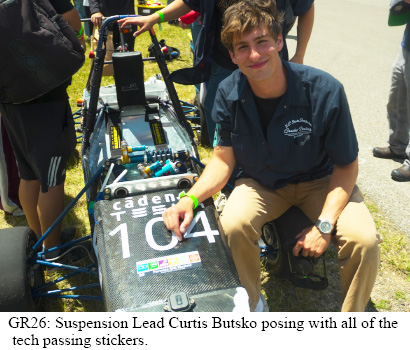
For a club founded only five years ago, the six inspection stickers affixed to its car represented far more than permission to race. They marked the culmination of four years of relentless redesigns, setbacks, and late nights in the machine shop transforming every problem into an opportunity for improvement.
“We weren’t aiming to become a top-10 team,” said Alexander Fu, a third-year mechanical engineering student and president of Gaucho Racing. “Our goal was simply to pass technical inspection. If that meant we could compete in the dynamic events, great — but first, we wanted to build a car that worked.”
Learning Through Adversity
Gaucho Racing first attended the Formula SAE Electric Competition in 2023 with a car that was not ready to compete. Although the vehicle never raced on the track, the experience gave students an opportunity to observe the inspections, understand the expectations, and see how more established teams operated.
"We were really there to understand how the competition worked," said Alexander Fu, a third-year mechanical engineering student and president of Gaucho Racing. "The car wasn't in a state where it could complete events, but it gave the team invaluable experience."
Progress followed. A year later, the team gained momentum. Students embraced a more disciplined design process, and successfully tested the car before competition.
“We actually got a couple miles of testing on Lagoon Road before competition," Fu recalled. "Watching that car drive was one of my favorite moments in Gaucho Racing." In 2024, the team earned its first mechanical inspection sticker.
Then came 2025. Determined to push the limits, the team introduced ambitious upgrades, including a four-motor drivetrain and a redesigned battery system. But the complexity proved overwhelming. "We kind of bit off more than we could chew," Fu said. The season ended without any sticker, but the team came back with a lesson that would redefine its approach: success starts with reliability, simplicity, and flawless execution — not complexity.
That change in philosophy shaped the 2026 vehicle.
Students improved the battery pack, redesigned the steering system, and focused on components that they could manufacture, test, and troubleshoot effectively. Building the car also required the students to operate as more than engineers.
Manas Bhargavan, a second-year computer engineering student and the internal vice president of Gaucho Racing, spearheaded funding efforts, raising nearly $90,000 to fund the 2026 season through support from UCSB’s Associated Students and the Undergraduate Research and Creative Activities (URCA) program. The team worked with forty industry sponsors who provided financial contributions, manufacturing services, and discounted products. The club also raised approximately $6,000 through individual donations during UCSB's Give Day campaign.
Finding a Way Forward
Even with all the work and planning, Gaucho Racing’s season was tested before competition officially began.
On the drive to Michigan, the truck transporting the team's race car and equipment broke down, forcing members to quickly reorganize transportation plans.
Once the thirty-member team arrived, challenges continued.
"Every time we solved one problem, another appeared," Bhargavan said. "We rewelded chassis tabs, discovered our high-voltage gloves had gone missing, and even sent a team member on a several-hour drive to replace them."
Under that pressure, the team’s organizational chart became irrelevant.
"Nobody was thinking about job titles or sub-teams," he said. "The only thing that mattered was getting the car through inspection, and everyone was willing to do whatever it took."
As the week progressed, the team's mindset evolved. The members began discussing strategy — whether to prioritize the design presentation or maximize points in the dynamic events.
"Just having that conversation showed how much our priorities had shifted," Bhargavan said. "Earlier in the week we were focused on getting the car through inspection. Now we were looking past that and making strategic decisions about where we could score the most points."
The transformation became real when the car cleared its final technical inspection and completed the acceleration event.
"It was the first time our car had ever moved under its own power on the Michigan International Speedway," he said. "I think that's when the whole team's mindset changed."
Wanting to maximize their performance in the remaining events, members decided a fresh set of racing tires could make a difference — even though they weren't in the budget.
"We asked if people would be willing to chip in," Bhargavan recalled. "Within a few minutes we'd raised around $1,200 from two dozen people. Nobody hesitated. Everyone had seen the car finally come to life, and everyone wanted to do whatever they could to help us finish as strong as possible."
For Bhargavan, that spontaneous act of teamwork captured what Gaucho Racing is all about.
"We didn't have a perfect week, but every time something went wrong, the team found a way forward," he said. "Watching everyone rally behind the car, and then seeing that effort turn into the best finish in Gaucho Racing's history, is something I'll remember for a long time."
A New Season
For Fu, the biggest victory wasn't just this season's performance — it was giving future teams a stronger starting point.
"Our next goal is to build on GR26 with realistic targets that lead to an even stronger car and better results," he said. "For the first time, we're not starting from scratch — we're building on a solid foundation, and that makes our future goals much more achievable."
That foundation changes what is possible for Gaucho Racing. Instead of devoting another season to reaching the starting line, the team can now focus on how much faster and farther it can go.

Formula SAE Electric Car built by members of Gaucho Racing.