
The Biomaterials, Polymers and Advanced Constructs from Integrated Chemistry Materials Innovation Platform (BioPACIFIC MIP), a collaboration between UC Santa Barbara and UCLA, provides a unique scientific ecosystem for the United States. The $19.8 million renewal empowers researchers associated with BioPACIFIC MIP to continue advancing the frontier of biobased materials, uniting synthetic biology, chemistry, automation, and artificial intelligence to reshape how materials are discovered, designed and deployed.
Launched in 2020 as one of just four MIPs nationwide, BioPACIFIC MIP is entering its second, and final, five-year phase. The renewed funding reinforces its national role as a user facility and a central hub for accelerating materials innovation while expanding its impact on research, workforce training, and the development of real-world solutions to pressing challenges.
“Renewing BioPACIFIC MIP is essential to keeping California and the U.S. at the forefront of sustainable materials innovation,” said Craig Hawker, co-principal investigator and director of the California NanoSystems Institute (CNSI) at UCSB, another partnership with UCLA, which was launched in 2000. “This program turns scientific breakthroughs into real-world solutions that benefit the U.S. economy while training the next-generation workforce.”
A National Platform for Next-generation Biomaterials
BioPACIFIC MIP accelerates the development of functional materials from biological building blocks. Its mission spans five integrated goals:
- Equipping researchers nationwide with access to cutting-edge instrumentation and expertise through an open-user program
- Employing high-throughput synthetic biology and chemistry to develop bio-based materials having high functionality and performance
- Bridging the molecular and macroscopic to understand how structure and function interrelate across scales
- Leveraging data science and AI, using autonomous experimentation and machine learning to dramatically reduce discovery timelines
- Training an interdisciplinary workforce for emerging industries at the intersection of biology, chemistry, materials research, and automation
Autonomous Experimentation: a New Era in Materials Research
A major emphasis of the NSF BioPACIFIC MIP’s second phase is the integration of robotics and artificial intelligence to enable autonomous experimentation. This transformation is designed to vastly accelerate discovery, eliminate bottlenecks, and move promising materials more quickly from the lab to real-world applications.
“This award reflects the remarkable efforts of our project scientists, faculty, students, and MIP community, enabling us to advance biomaterials innovation and usher polymer synthesis into the era of robotic platforms,” said Javier Read de Alaniz, UCSB professor of chemistry and biochemistry and BioPACIFIC MIP co-director and PI. “Looking ahead, we are energized to expand BioPACIFIC MIP’s impact, accelerating high-throughput experimentation and leaving a lasting legacy by training a generation of scientists at the forefront of materials science.”
Unlocking Innovation through Collaboration
Since opening to users in 2021, the broad national impact of BioPACIFIC MIP has been demonstrated by supporting approximately 130 research projects across 22 states, including many from institutions that have not had previous NSF platform access. For example, as a result of the expertise, access to facilities, and mentorship he received at BioPACIFIC MIP, one assistant professor at the University of Southern Mississippi was able to launch his scientific career and receive funding for a large piece of equipment for the university.
“BioPACIFIC MIP is a user-facility open to researchers across the U.S.,” said Read de Alaniz. “Our centralized, state-of-the-art facility and in-house expertise allow users to lead their own research programs, bringing together R1 institutions — primarily undergraduate institutions — and non-R1s alike in pursuit of next-generation materials.”
This infrastructure reflects UCSB’s collaborative, interdisciplinary orientation by enabling cross-pollination of research ideas, which accelerate breakthroughs in fields ranging from degradable plastics to advanced microelectronics and sequence-defined polymers.
Impactful Research, Powerful Tools
Since the facility opened, in-house researchers have led major advances, including:
- Developing on-demand degradable adhesives for packaging and recycling
- Engineering materials having precisely defined molecular sequences for microelectronics, paving the way for higher data density and next-gen computing
- Working with partners such as BASF to develop biodegradable plastics that could one day replace non-degradable versions
- Fostering technology translation and entrepreneurship and supporting startups including Praio, FLO Materials, and Saku Biosciences, which commercialize materials, workflows, and biotechnology developed at BioPACIFIC MIP
The platform was built with the goal of connecting fundamental research with industry needs as part of an effort to to establish Southern California as a hub for biomaterials innovation. By significantly reducing barriers to university-industry collaboration, the platform opens doors for accelerated commercial development.
“The NSF BioPACIFIC MIP has provided an ecosystem that is unique in the United States,” said Heather Maynard, Dr. Myung Ki Hong Endowed Chair in Polymer Science at UCLA, as well as co-director of the MIP,and co-PI and associate director of CNSI.
“Users from across the country can utilize one-of-a-kind equipment and take advantage of extraordinary expertise in an environment that greatly accelerates research in polymers and biomaterials,” Maynard added. “This benefits the nation by providing paradigm shifts in how new materials are discovered and characterized. I am thrilled that the NSF has enabled us to continue this work.”
Training the Future Workforce
Workforce development is another key component of the BioPACIFIC MIP mission, and already, more than one hundred graduate students and postdoctoral fellows have benefited from interdisciplinary training in automated synthesis, data-driven experimentation, and synthetic biology.
“Because we combine interdisciplinary research with high-throughput experimentation, we’re training students in a way that aligns with industry needs,” said Read de Alaniz. “Our ecosystem equips them with hands-on experience in robotics, AI, and polymeric materials synthesis, giving them a true competitive edge.”
“As a National User Facility, BioPACIFIC MIP is providing critical national infrastructure for all researchers to bridge biological synthesis with the making of new functional materials,” said Rachel A. Segalman, professor of chemical engineering and vice chancellor for research at UCSB. “This is incredibly important not just for positioning UCSB at the forefront of this important field, but also in terms of training a broad workforce and providing resources for a research community far beyond our campus.”
Powering Discovery with Digital Infrastructure
BioPACIFIC MIP has also built a robust digital ecosystem linking electronic lab notebooks, data sharing, and AI-powered analytics into a cohesive infrastructure.
“This digital backbone allows us to capture successful and unsuccessful experiments alike,” Read de Alaniz explained. “Now, we can build high-quality datasets to fuel machine-learning models that will dramatically improve the speed and success of materials discovery.”
The next five years will see further investment in this digital infrastructure, a critical step toward fully autonomous discovery workflows envisioned by the Materials Genome Initiative — a federal effort to shorten the timeline for developing advanced materials. As co-PI Yi Tang, professor of chemical engineering and chemistry at UCLA, said, “This renewal positions CNSI at the forefront of advancing the next generation of biomanufacturing and AI-programmable laboratories.”
“This renewal affirms the critical role BioPACIFIC MIP plays in advancing scalable platforms for bio-derived and bio-inspired materials,” said Umesh Mishra, dean of The Robert Mehrabian College of Engineering at UCSB. “The collaborative model between UCSB and UCLA continues to enable transformative research at the intersection of biology, chemistry and materials science. I commend our faculty, researchers, and staff for their vision and leadership in building the materials infrastructure of the future and driving innovation that has global impact.”
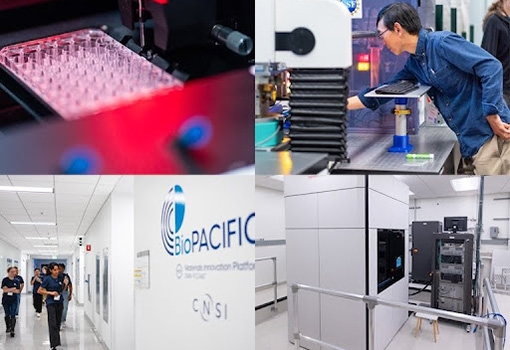
State-of-the-art research facilities at UC Santa Barbara and UCLA support impactful discoveries in materials science through the BioPACIFIC MIP.