
Whether biological or manmade, polymers, the large molecules comprising long chains of shorter molecules, called monomers, exhibit complex structure and characteristics that make them useful in a wide variety of applications. In the nearly liquid biogel phase, polymers viewed with an optical microscope resemble a bowl of tangled soft noodles. In that state, they have a tendency to coacervate, or combine, with other polymers, if those polymers carry opposite electrostatic charges.
UC Santa Barbara materials professor and chair, Omar Saleh, has decades of experience in measuring and characterizing polymers. He recently received a three-year, $441,000 grant from the National Science Foundation (NSF) to conduct refined experiments aimed at better understanding the fundamental nature of complex coacervates. “In this project, we aim to understand how mixtures of charged polymers called complex coacervates can form microscopic droplets having unique properties, such as the ability to encapsulate and deliver drugs and act as adhesives,” he says, adding that, while his group is not aiming for a specific application or technology, the biological polymers he is focusing on — hyaluronic acid and RNA coacervates — reflect broader interest in applications that include drug delivery and cosmetic products.
Saleh’s lab is a good place for such research, because not only do he and his team specialize in taking exacting measurements of very small entities at the nanometer scale, but, Saleh estimates, his is one of perhaps ten labs in the world involved in nanoscale measurements of microgel polymers using instrumentation they build. The tool, referred to as magnetic tweezers, is used to measure small changes in polymers under various forces. It is, Saleh says, “a unique, high-precision characterization technique in which we use the magnetic field to apply a tiny, well-known, and well-controlled stretching force to the polymer while measuring its extension to within one nanometer of accuracy.
“Other people are also good at this,” he adds, while acknowledging that he has something of a head start. “I started developing some of the things when I was a postdoc with a group in Paris,” he says. “We’ve done pretty well with it over the years, and recently we developed a way to use that instrument to study a particular problem associated with coacervation, which is: how does the conformation of a polymer (i.e., its shape after being pulled on by the tweezers) affect coacervation?
That granularity is important because, of course, one nanometer is a lot smaller than a polymer, which, when stretched, is about a hundred to a thousand times as long as that. “Our one-nanometer accuracy enables us to sense very small changes in the shape of the polymer as it undergoes interactions with other things in the environment,” Saleh explains. “We set up a high-precision sensor, which is a stretched polymer, and then something binds to it, and it changes length, and we're able to measure that and, from this precise measurement, quantify in excruciating detail everything the polymer is doing.”
On the one hand, polymers in the fairly disorganized microgel state bind in an atypical way. “It's like a wiggly, sticky ball of noodles,” Saleh says. “The fact that it holds together — but not as it would in a typical binding or phase transition to a solid, where everything becomes rigid afterwards — makes the microgel phase physically interesting. It also makes it very hard to measure, because you can't do X-ray crystallography on it, for the simple reason that there is no crystal structure when the polymer is in the semi-liquid state we're talking about.”
But, there is the little ball of noodles and the droplets in it, which might one day be used to deliver drugs or, because it’s very sticky, be used as an adhesive, a glue for surgery, perhaps.
Any such application will require gaining an increased understanding of the fundamental science behind the coacervate state. That is no small challenge, leading Saleh to note, “The ‘ball of noodles’ is a very complicated and tricky physical situation, and if we want to engineer it, we need to understand it better, so, what we're going to do in this project is to use our high-resolution measurement technique to understand it better, and that should enable a range of applications in the long run.”
There is a lot of promise for what can be done with polymers in this state, and, says Saleh, “Certain applications are coming out.” But they are based mostly on what, he says, is “empirically applying” what is known about the coacervate state. That is, he explains, “You can find something that works without having to understand how it works. And you can try to make a product that way. And that's not a bad way to do things; it's very practical. But obviously, from a scientific point of view, it's interesting to try to solve some of the fundamental problems, and it almost always turns out that solving those fundamental problems opens up new applications or do things in a better way.”
The research will be buttressed by the work of Mark Stevens, an expert in simulations who works at Sandia National Laboratories. He can simulate what Saleh describes as “the quite novel geometry for the [stretching] experiment, creating a decent facsimile of the experimental geometry, and we can draw insights from what the simulation shows. That will be very important for this experiment because we’re not just carrying out the same kind of experiment that has been done for years, or buying an instrument that does this well-established procedure. For us, it’s all quite new, so we have to develop new interpretation techniques, and the simulation will help with that.”
He hopes that the work will reveal “the role of polymer configuration, ionic strength, temperature and polycation architecture in determining phase behavior, and establish a new physical framework for understanding tension-modulated complex coacervation.”
In describing the project, Saleh highlights two important aspects of the project: first that he will be able to hire a PhD student to support the effort, contributing greatly to the training that student will receive, and second, that NSF continues to fund important research.
“This is a very specific niche of STEM work and a specialized technique, but the training is really broad in the sense that if you can build and use this instrument, you can build and use a lot of instruments,” Saleh says. “There are many fundamentals of quantitative science and polymer science that this person is going to learn that will have a huge application in a variety of fields.”
Regarding NSF funding, Saleh says, “NSF support is so important to the American economy. Without funding, research doesn’t happen, and we need to be reminded of this. The funds will directly support a graduate student who will get trained in these advanced methods and then go out and join the economy and push our technological capabilities and the scientific establishment. That is what we do.”
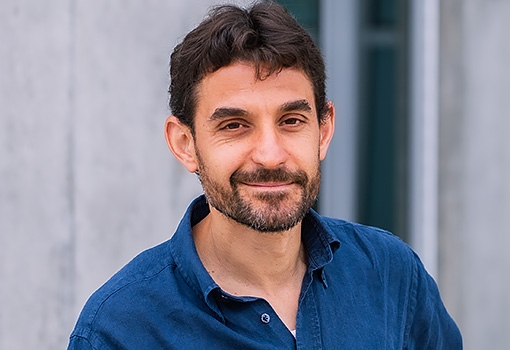
Materials Department professor and chair, Omar Saleh. Photograph by Lilli Walker.