
Charlott Vallon, currently a postdoctoral researcher and lecturer in the Mechanical Engineering Department at UC Berkeley, will be joining The Robert Mehrabian College of Engineering’s Mechanical Engineering Department as an assistant teaching professor in November 2025. She earned her bachelor’s degree from UC Berkeley, completed her MS at ETH Zürich, and then returned to UC Berkeley to complete her PhD. Vallon’s postdoctoral research focused on restructuring the hierarchy of learning controls for fleets of autonomous agents, such as electric buses or lunar rovers. Celeste Natera spoke with her earlier this month.
COE: Why are you excited to join UCSB's Mechanical Engineering Department?
CV: I'm excited about joining a really collaborative and innovative department that prioritizes and invests in the student experience.
COE: Can you talk a bit about your research and its real-world implications?
CV: I'm fundamentally interested in decision-making for complex cyber-physical systems, systems that integrate both computation and physical processes. In most control systems, decision-making occurs at multiple levels and timescales. Consider a fleet of autonomous electric buses, where a high-level controller assigns vehicles to particular routes, and vehicle-specific low-level controllers are responsible for actually executing the assigned route. The classical approach to ensure that vehicles can complete assigned routes without failure, like unexpectedly running out of charge, is to use really conservative models of energy at each control level. Since modeling the vehicle's true energy consumption is complex and variable, we make a "safe" plan, as if each route will take a lot more energy to complete than it actually will. Unfortunately, this conservatism leads to vehicle underutilization and general inefficiency, which, in turn, prevents widespread adoption of new electric-vehicle technologies. Similar challenges appear when designing control algorithms for other dynamically complex systems having time or energy constraints that make consumption difficult to model.
COE: Can you talk a little bit about the nature and importance of “cyber-physical” systems?
CV: As cyber-physical systems become increasingly interconnected with society, new control methodologies are required to coordinate them to maximize performance while ensuring safety and resilience. One idea to improve efficiency despite system-model uncertainties is to integrate AI tools to collect system data to reduce modeling conservatism. However, because data-driven techniques can lack traditional performance guarantees, which are crucial for systems that affect the safety and well-being of people, they are not suited for controlling large-scale systems having multiple levels of decision-making. I'm interested in finding new ways to combine AI tools and existing control theory to design innovative decision-making algorithms that are flexible and appropriate for real-world use.
This is a broad research problem that requires interdisciplinary approaches and collaboration — like so much of the ongoing research at UCSB. The UCSB research and coursework infrastructure is set up to foster this kind of collaborative work, and I'm excited to tackle this challenge with excellent colleagues, students, and industry partners.
COE: What do you see as your biggest goal at UCSB?
CV: The incredible level of innovation in recent years in robotics, AI, and control has completely changed both academia and industry. It can also feel overwhelming. My goal is to develop a hands-on curriculum and research program that prepares students to understand contemporary controls and robotics methodologies, excites them about leading these changes, and encourages them to contribute in meaningful and responsible ways.
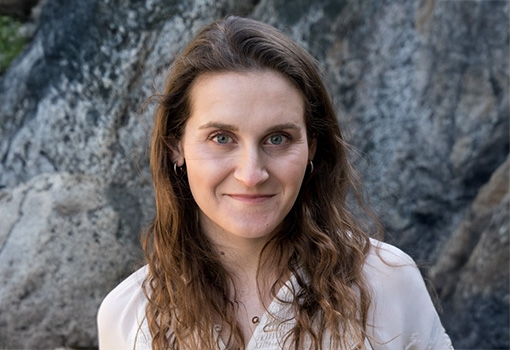
Charlott Vallon, assistant teaching professor of mechanical engineering.