
UC Santa Barbara researchers have designed and built a device that expands the ability of laser scanners to create rapid, high-resolution images of samples under a microscope, enhancing scientists’ ability to study the brain’s neural networks. The invention, called a scan angle multiplier, expands the angle at which a laser beam can sweep across a sample, while maintaining high resolution and imaging speed — an issue that has stymied previous efforts to expand the field-of-view for high-resolution laser scanning systems.
Most current high-resolution microscopes allow neuroscientists to study the activity of perhaps two hundred neurons at a time. “But, in order to understand how the brain works, we want to look at the network and see how the neurons talk to each other,” says Che-Hang Yu, a postdoctoral researcher working with electrical and computer engineering professor Spencer Smith. “Our brain is quite large, so we want to see hundreds of neurons, thousands of neurons,” Yu says, “with the ultimate goal of being able to look at how individual neurons work together across the entire brain.”
Along with being an important part of his lab’s neurobiology research, Smith says, “Laser scan engines are used for all sorts of applications, including LIDAR, supermarket scanners, laser marking, cutting, and more. In all of these applications, it was accepted that if you wanted to scan large-diameter beams, over large angles, quickly, you had to pick two of those three,” he says. “There had to be a trade-off.”
In a paper that appeared last month in the journal Optica, Smith, Yu and their colleagues at UCSB outline an approach that allows them to do all three. “This work breaks a so-called ‘invariant’ property of laser scan engine design,” Smith says. To confirm that their approach worked in practice, the researchers built the scan angle multiplier and used it to image a mouse’s brain, recording more than two thousand neurons in action across a large field-of-view, effectively quadrupling the area that could be scanned without their device, with no decrease in scan speed or resolution. “We proved that it worked in the most demanding application: high-resolution laser scanning microscopy.”
Better Optics, Better Science
Yu began building microscopes as a masters’ student at National Taiwan University, then got his PhD at Harvard University, where he conducted cell biology research. The more he learned about lab techniques, the more he realized that the instruments he and other scientists used often limited the types of questions they could ask.
One of these limitations has been in laser scan engines, which work, in part, by pointing a laser at a rotating mirror that reflects the laser beam and moves it across a sample or specimen. “We need to scan the laser beam across the sample, point by point, to capture the image. So if the sample becomes larger, it takes more time to cross the entire area,” Yu says. As the sample becomes larger, the mirror that directs the laser beam also needs to increase in scan angle; however, the bigger the mirror, the more difficult it is to move quickly and accurately. And if the mirror size is reduced, then that reduces the resolution of the imaging as well. “We want to have a fast scan, large-amplitude scan, with a large diameter beam,” Yu says, “but physics doesn’t allow us to do it.”
Yu started to wonder whether he and his colleagues could build new optics for the scanner that would improve its usefulness. Working at his whiteboard, Yu came up with a device that uses a series of mirrors and lenses to reflect the laser beam and allow the angle that it scanned to double.
He built the system, and then worked with postdoctoral researcher Yiyi Yu (no relation) and Yuandong Fei, a PhD student in the Smith lab, to use the device, called a scan doubler, to image the brains of living mice. In a viewing area of 1.7 x 1.7 square millimeters, the researchers were able to see at least 1,507 active neurons without losing any resolution or speed.
Yu got stuck, however, when he started thinking about how to expand the laser’s reach even further. He and a colleague, PhD student Joe Canzano, returned to the whiteboard, coming up with potential ideas — so many ideas, in fact, that they ran out of whiteboard space and started to write on Yu’s office windows. With this work in mind, and with the help of PhD student Filip Tomaska, Yu designed and built another device, a scan angle multiplier, that increased the scanner’s useful range to 3.15 x 3.15 square millimeters, while still maintaining speed and image quality.
"It was a eureka moment, to break this limit imposed by physics," Yu says, a moment, he notes, that wouldn't have been possible without his colleagues: “If any of them had not participated, then I would still be stuck doing the biology experiments and slowly analyzing data.”
The researchers are now able to further increase the amplitude of the scan angle multiplier by making additional changes inside their invention. They have started a company, called Pacific Optica, to produce their scan angle multipliers and to make this and other optical technology available to researchers around the world.
Yu is motivated by the idea that his work may help scientists ask new questions. “People really want to understand how the brain works. I want to be part of that,” he says. “Hopefully, people can say our product is one of the critical tools that helped them figure out the answers.”
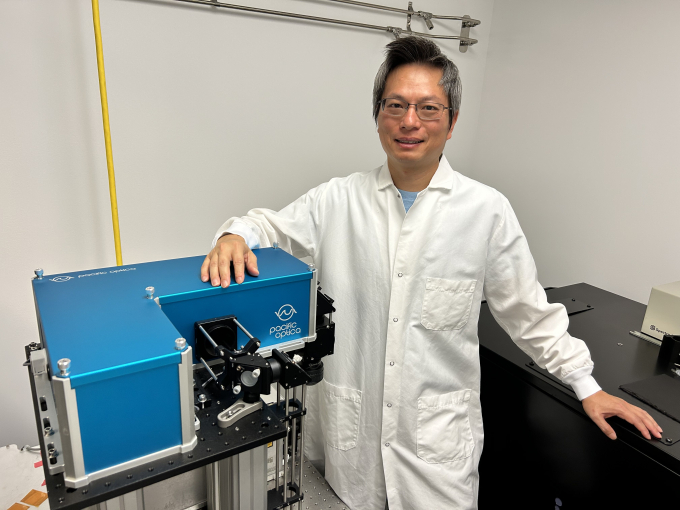
Study lead author Che-Hang Yu in his lab.